
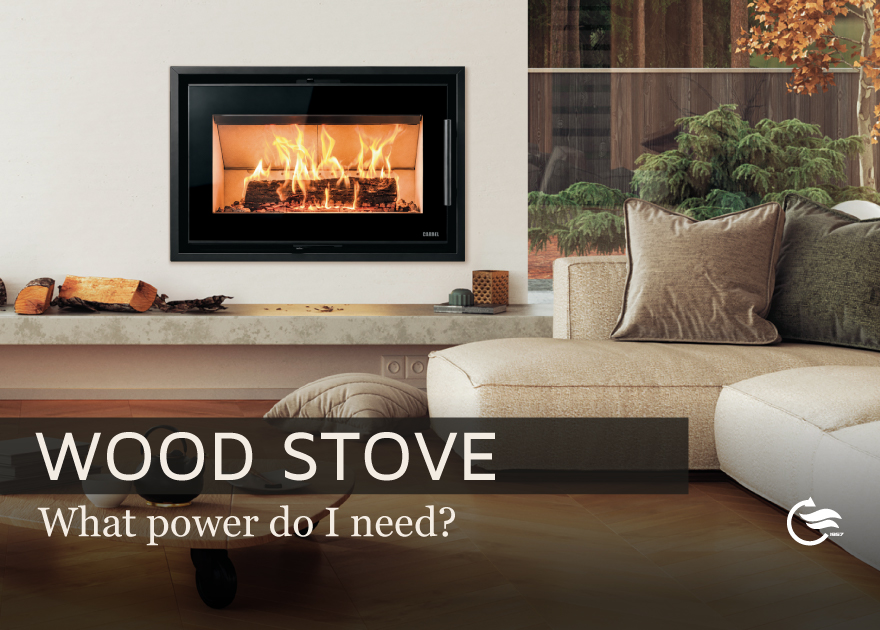
Quick answer: The right heat output for a wood-burning stove depends on how much heat your home loses. To choose the right kilowatt (kW) rating, consider floor area, room volume, insulation, local climate and layout. Square metres alone will not give you the answer.
Two homes measuring 80 m² can have very different heating needs. A well-insulated, open-plan home retains and distributes heat differently from one with older windows and walls and separate rooms.
What does a wood-burning stove’s kW rating mean?
Kilowatts (kW) measure a stove’s heat output. Its nominal heat output allows you to compare models under defined operating conditions. This is different from efficiency, which tells you how much of the energy in the wood is converted into useful heat.
Choosing a higher output than you need will not necessarily make your home more comfortable. An oversized stove can overheat a room and encourage unsuitable operating habits. An undersized stove may struggle on the coldest days.
Five factors that determine the heat output you need
Floor area. Square metres are a useful starting point, but they do not tell you how much heat a space loses. An enclosed living room and an open-plan area of the same size can have different heating requirements.
Room volume. Ceiling height matters too. A 40 m² room with a 2.5 m ceiling has a volume of 100 m³. Raise the ceiling to 3.5 m and the volume becomes 140 m³. Volume helps define the space you want to heat, although it cannot determine the required kW rating on its own.
Insulation. External walls, roofs, windows, floors and draughts all affect heat loss. A well-insulated home generally needs less heat to maintain a comfortable indoor temperature.
Climate. Outdoor temperatures, wind and your local climate all influence heating demand. A home heated every day will also behave differently from one left unheated for several days.
Layout. A stove primarily heats the room in which it is installed. Doors, internal walls and corridors can prevent warmth from reaching other rooms. It is important to decide which areas you actually want to heat.
How many kW do you need for a 50, 80 or 100 m² home?
There is no universal formula that converts square metres into kilowatts. General sizing charts can offer a starting point, but they cannot replace a heat-loss calculation. Two homes with the same floor area may need very different stoves.
For an informed choice, a qualified professional should assess the building envelope, local climate, target indoor temperature and layout. Spain’s Technical Building Code (Código Técnico de la Edificación) provides a technical framework for understanding how these factors affect energy demand.
Heat output and efficiency: why both matter
Heat output tells you how much warmth a stove can deliver. Efficiency describes how effectively it uses its fuel. You should check both figures in the model’s technical specifications, alongside its installation and operating instructions.
For an example of different heat outputs, the Carbel RS range includes the RS-60 (4.4 kW), RS-70 (5.5 kW) and RS-80 (6.7 kW). These ratings do not automatically correspond to recommended room sizes. The right choice depends on the property.
Frequently asked questions
Does a higher-output wood-burning stove always use more logs?
Not necessarily. Wood consumption also depends on efficiency, fuel load and how the stove is used. The key is to match its output to your heating needs and follow the manufacturer’s guidance.
Can a wood-burning stove heat an entire house?
It depends on the layout, insulation and stove itself. A stove in the living room cannot guarantee an even temperature in distant bedrooms or rooms separated by doors.
What happens if I choose a stove with too many kW?
The room may become uncomfortably hot. Constantly restricting combustion beyond the manufacturer’s recommended operating conditions is not a good solution either. Correct sizing matters.
Installation requirements also need checking, including flue arrangements, combustion air supply and safe clearances. The stove’s technical specifications and manual set out the requirements for safe, efficient operation.
Find the right warmth for your home
At Carbel, we design wood-burning stoves for a range of heating needs. Before choosing a model, we recommend assessing your home’s characteristics. Explore our technical specifications and consult a qualified professional about installation.
The best stove is not the one with the highest kW rating. It is the one that delivers the right level of comfort for your space.